
Religion, Power and Global India – a guest lecture as part of the Europe Days celebrations at West Ukrainian National University
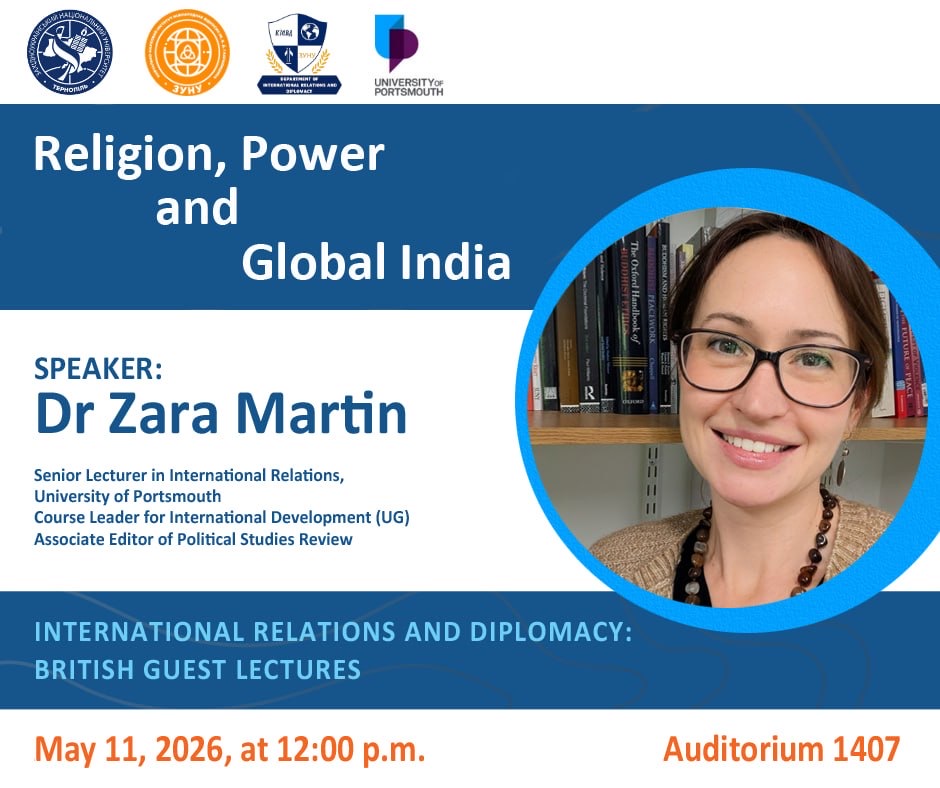 The educational platform ‘International Relations and Diplomacy: British Guest Lectures’, organised by the Department of International Relations and Diplomacy of the B. Havrylyshyn Education and Research Institute of International Relations, is offering students, lecturers and all interested parties the opportunity to take part in a unique event – a lecture on ‘Religion, Power and Global India’, which will be held as part of the Europe Days celebrations at West Ukrainian National University.
The lecture aims to promote a deeper understanding of global political processes and comparative models of democracy, thereby broadening European academic discourse in the context of contemporary challenges. The lecture will be held with the support of the Vice-Rector for Academic Affairs and Research Uliana Koruts and the International Relations Office of WUNU.
Dr Zara Martin, a guest speaker from the University of Portsmouth (UK), will be giving a talk tailored specifically for students on the International Relations degree programme. Dr Zara Martin is a Senior Lecturer in International Relations and Course Leader for International Development (Undergraduates) at the University of Portsmouth, as well as Associate Editor of the Political Studies Review journal.
This lecture will explore the rise of Hindutva as a political ideology in contemporary India and examines how religion, populism, and power intersect to reshape ideas of national belonging. Using Ayodhya as a central case study, the speaker will trace how historical narratives have been mobilised to frame India as a fundamentally Hindu nation, legitimising various processes of marginalisation in law, politics, and everyday life. Dr Zara Martin will demonstrate the pivotal role of Narendra Modi in embedding this project within the state, and argues that under his leadership Hindutva functions as a majoritarian political project that challenges India’s secular constitutional vision. The lecture will also include a reflection on the implications of these domestic developments for Indian foreign policy.
We invite you to join us on 11 May 2026. The event will begin at 12:00 and will run until 13:10 (Room 1407).